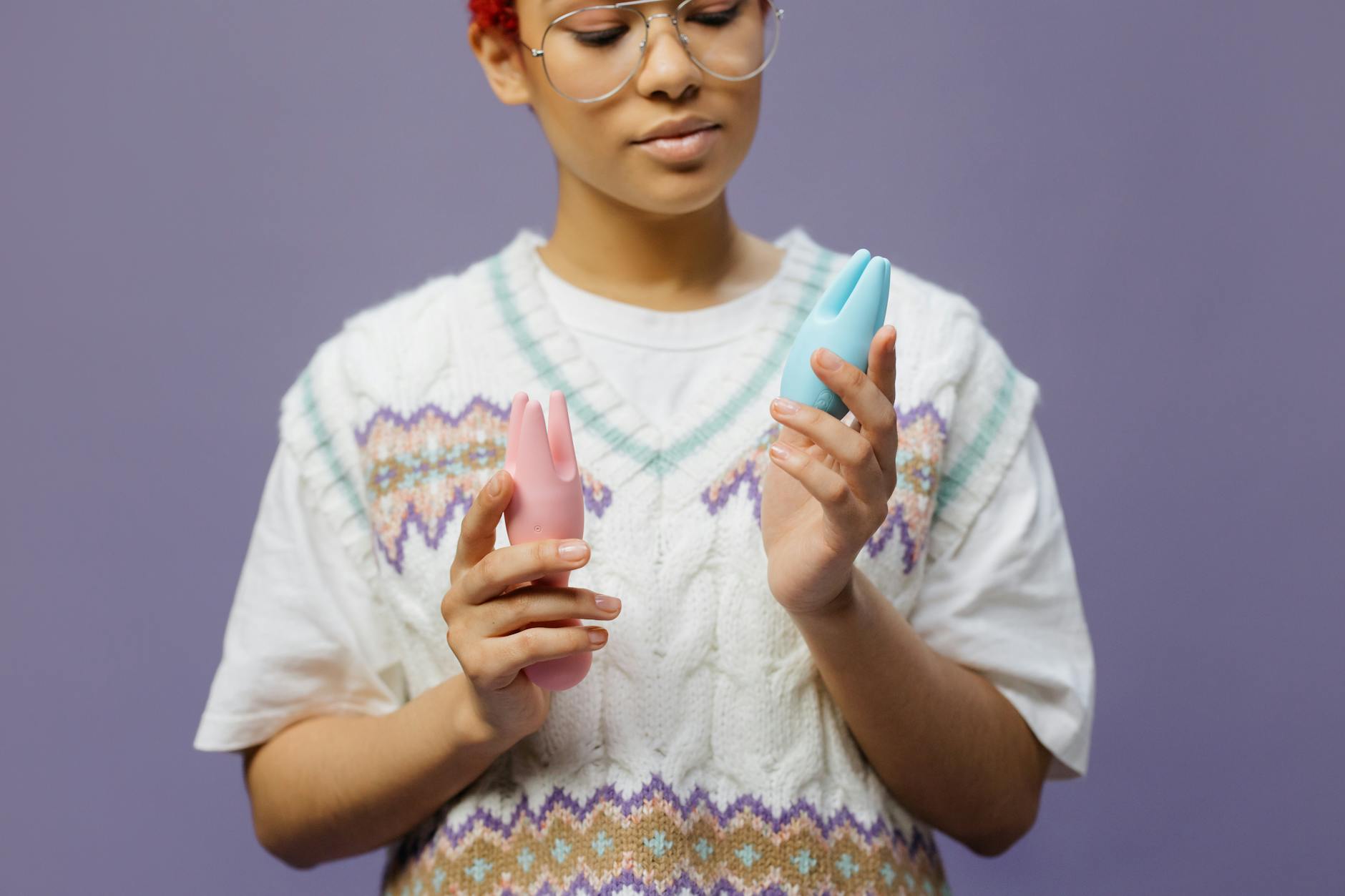
Performance anxiety doesn't care that you know, intellectually, that you're safe. Your nervous system is still in fight-or-flight mode. Blood is pulling away from the genitals and toward your limbs. Your clitoris stays uninvolved. Your brain is running a constant loop of "Am I doing this right? Do they like this? Am I taking too long? Is this working?"
That's not passion. That's a stress response disguised as sex.
What most people don't realize is that clitoral vibrators like the Lem work partly through pure sensation, but partly through something quieter and more powerful. They interrupt the anxiety loop by hijacking your nervous system in the other direction. Not sympathetic (fight-or-flight), but parasympathetic (rest-and-digest). The suction and pulsing are so intensely pleasurable that your brain literally cannot run the anxiety script and feel the vibration at the same time. One system wins. Usually, it's the pleasure.
When you're worried about performance, your body does exactly what it's supposed to do in a threat situation. Blood redirects to large muscles. Cortisol and adrenaline spike. Your clitoris becomes less sensitive because getting aroused isn't the priority when you're running from a lion.
The problem: there's no lion. But your nervous system doesn't know that. It responds to the thought of failure the same way it responds to an actual predator.
This is called spectating, and therapists have been talking about it for decades. You're observing your own performance from the outside instead of being inside the experience. You're the audience and the performer at the same time, which means you're never fully present in either role.
For some people, this anxiety is situational. New partner, new relationship, pressure to perform in a specific way. For others, it's deeper. Years of messaging that your pleasure isn't important, or that you need to prioritize someone else's experience, or that there's a "right" way to have an orgasm.
Your brain has a limited capacity for attention. This isn't a flaw. It's a feature. Right now, you're reading this. You're not calculating quantum physics or composing a symphony, because you only have so much mental bandwidth.
The same is true for pleasure and anxiety. They compete for the same neural real estate.
When you introduce a tool like a lemon vibrator, especially one with a suction or pulsing pattern, the sensation is so distinct and novel that your prefrontal cortex (the part that's running the anxiety script) has to step back. Your somatosensory cortex (the part that processes physical sensation) takes over. The chatter quiets. The inner critic loses bandwidth.
This is different from using your hand, because your hand is predictable to your nervous system. You know what your hand feels like. Your brain can split attention between the sensation and the worry. A vibrator introduces novelty and intensity that are harder to ignore.
Lemon clitoral vibrators aren't just vibrating randomly. They pulse. They build. They have patterns that shift and change. This matters because your nervous system is pattern-recognition machinery. When something follows a predictable rhythm, your brain relaxes slightly. Your body begins to anticipate the next pulse. It's like dancing to a beat.
Anxiety is chaotic. Your thoughts scatter. Your breath shallows. Rhythm pulls you back into the present moment, because the body tracks rhythm more reliably than the mind tracks worries.
Suction vibrators particularly help with this because suction is a fundamentally different sensation from standard vibration. It's not something most people have experienced before, so there's less room for comparison or judgment. It just feels new and intense, which can be enough to break the anxiety pattern.
One of the biggest shifts I see with clients using lemon vibrators for the first time is that their attention moves outward instead of inward.
Instead of monitoring your own response (Am I wet enough? Am I getting close?), you're focused on the sensation of the device. The pattern. The intensity. What feels good right now, this second. Not whether you're progressing toward an orgasm fast enough. Not whether your body is responding the "right" way.
This sounds small, but neurologically, it's massive. External focus activates different parts of the brain. It pulls you out of the self-surveillance mode that anxiety creates.
When you're anxious during solo play, a vibrator offers something your hand can't: it offers you a reason to focus on something other than your own performance. You have to pay attention to the device. You have to adjust position or intensity. There's something between you and your anxiety.
This is less scientific and more psychological, but it matters. When you introduce a tool into your pleasure practice, you're often saying, implicitly, "I deserve this. I'm allowed to focus on sensation." That permission structure can quiet shame and anxiety on its own.
Some people grow up thinking that pleasure should be passive, that it should happen to you rather than something you actively create. Using a device like the Lem pushes back on that. You're making an intentional choice to prioritize your own sensation. You're not waiting for someone else to get it right.
For people with performance anxiety particularly, this shifts the entire frame. You're not being judged. You're not trying to perform. You're just exploring what feels good. That's it. The permission to simply feel, without outcome attached, is often where the magic happens.
If your performance anxiety shows up only with a new partner or in specific situations, lemon vibrators are a straightforward tool. They help you reset your nervous system before or during intimate time. Many people find that once they've felt the parasympathetic response a few times, it becomes easier to access even without the device.
But if anxiety is more pervasive. If you feel it solo, with partners, in all contexts. If it connects to deeper beliefs about your body or your worth. That's worth exploring with a therapist, because a vibrator alone won't solve that. What a vibrator can do is give you a break from the anxiety, a felt sense of pleasure that contradicts the narrative your mind is running.
That break matters. It plants a seed. Over time, repeated breaks start to shift the belief.
No tool cures anxiety on its own. What lemon vibrators do is create a window where anxiety quiets down, and you can feel pleasure without the noise. That window expands with repetition. Many people find that the parasympathetic response they learn to access with a vibrator becomes easier to activate naturally over time, but that's different from the vibrator being a cure.
Start alone. Build a baseline of what pleasure feels like without the pressure of someone else's experience. Once you've felt the shift out of anxiety solo, introducing a vibrator with a partner is much easier. At that point, it becomes a shared tool rather than something you're leaning on because something's wrong.
This is a common worry and worth addressing directly. The short answer is no. What vibrators do is help your nervous system recognize what pleasure actually feels like beneath the anxiety. That recognition usually makes natural arousal easier, not harder. The anxiety was the barrier. The vibrator removes the barrier temporarily so your body remembers what's possible.
Some people feel it immediately. Others need a few sessions to relax into it. Your nervous system isn't used to the sensation, so it might take time to stop bracing against something new. Be patient with yourself. The goal isn't orgasm; it's just feeling something different than anxiety.
That's a different layer, and worth working on with a therapist. Vibrators can help with the physiological anxiety response, but if the anxiety is rooted in shame about how you look or what you deserve, that's internal work. The vibrator is a tool that can coexist with that work, but not a replacement for it.
Absolutely. Performance anxiety in men often shows up as pressure around erection or lasting long enough. While lemon vibrators are marketed toward people with vulvas, the nervous system principle holds for everyone. Partners using vibrators together, or exploring different sensations, can reduce performance pressure across the board. The shift from goal-oriented sex to sensation-oriented sex helps anyone trapped in the anxiety loop.
Performance anxiety is so common that most people think it's normal. It's not normal. It's a sign that something in the context of sex has made you feel unsafe. Maybe it's a specific relationship dynamic. Maybe it's broader cultural messaging about what sex should look like.
Lemon vibrators don't solve the context problem. But they do interrupt the nervous system response, which gives you space to remember that pleasure is possible, that your body is capable, that you don't have to perform to deserve sensation.
Start there. Feel that. Everything else can follow.
If anxiety is significantly impacting your intimate life or relationship, consider reaching out to a therapist or coach who specializes in sexual health. You don't have to figure this out alone. And a vibrator, like the lemon clitoral vibrator, can be a valuable companion to that work. Learn more about how to explore pleasure at your own pace by visiting our buying guide or reaching out to us at /contact.